 ValourAI
AI spending is exploding across every industry. Boardrooms are mandating artificial intelligence roadmaps, software vendors are injecting copilots into every product, and enterprise tech budgets are swelling to accommodate new subscriptions.
Yet behind closed doors, CFOs, operations directors, and founders are grappling with an uncomfortable reality that few public PR releases mention: Is our AI investment actually increasing productivity, or are we simply accumulating technology overhead?
If you have deployed AI tools but struggle to pinpoint their tangible contribution to your bottom line, you are not alone. Discovering how to use AI to increase business productivity requires moving past generic chatbot prompts and redesigning core operational systems around automated workflows and hard financial metrics.
The AI Spending Boom vs. The AI Revenue Gap
A recent analysis highlighted by The Economist exposes a stark divide across the global AI economy. Major technology infrastructure providers are pouring hundreds of billions of dollars into data centers, specialized chips, and training clusters. However, the identifiable commercial revenue generated from AI applications sits around $150 to $220 billion annually.
By contrast, economic research estimates that roughly $2.5 trillion in annual revenue will eventually be needed to justify the current scale of AI capital expenditure (Mint / The Economist analysis).
Identifiable AI revenue is roughly $150–220B today. It will take $2.5 trillion in annual enterprise value to justify the capital being deployed.
Does this mismatch suggest that artificial intelligence is merely a speculative bubble? Not at all. It points to something far more consequential for operators:
Most companies haven't yet learned how to extract genuine economic value from AI.
The gap between infrastructure spend and commercial return is not a limitation of AI model intelligence; it is a symptom of how organizations approach execution. And that gap is precisely where the greatest competitive advantage lies for forward-thinking businesses.
The Real Problem: AI Adoption vs. AI Implementation
When leadership asks whether an organization is utilizing AI, the answer is almost universally affirmative. Nearly every team can point to active accounts and exploratory usage:
- An employee opens ChatGPT or Claude to draft a difficult email or revise phrasing.
- A software developer enables an AI code completion copilot in their IDE.
- A marketing associate generates captions or outline ideas for social media posts.
- A project manager uses an automated AI recorder to transcribe and summarize weekly meetings.
These individual applications are convenient, but they do not transform an enterprise. They represent superficial AI adoption—fragmented, ad-hoc personal productivity hacks that rarely move the needle on company margins, turnaround speed, or customer retention.
The fundamental breakdown in enterprise value occurs because organizations mistake individual tool adoption for operational AI implementation.
From "Using AI" to AI-Powered Process Automation
Substantial economic gains only materialize when artificial intelligence ceases to be an external tab in a browser and becomes an integral component of a company's operational workflow.
Consider the difference between a traditional manual workflow and an engineered AI process automation pipeline:
| Dimension | Surface AI Adoption ("Using AI") | AI-Powered Workflow Automation |
|---|---|---|
| Primary Action | Human copies text into a web chat to get ideas or rewrite sentences | AI autonomously ingests, parses, extracts, and validates structured data |
| System Integration | Isolated silo; zero connection to internal databases or ERPs | Bi-directional sync with CRM, ERP, relational databases, and ticketing APIs |
| Human Effort | Employee still handles every step manually before and after the prompt | Human is only looped in for edge cases, anomalies, and high-stakes judgment |
| Scalability | Linear with staff headcount (more work requires more employees prompting) | Exponential (system processes 10x volume with zero added operational staff) |
| Measurement | Subjective feeling ("the team likes having the assistant") | Objective metrics: hours saved, cost reduction, error rate, SLA velocity |
Take customer service, claims, or vendor request processing. In a conventional company, an employee manually opens an incoming request, reads it, checks an internal database, determines the issue type, drafts a reply, updates a CRM record, and routes a ticket. Performing this across 1,000 requests consumes hundreds of expensive employee hours.
In an engineered pipeline, the architecture looks radically different:
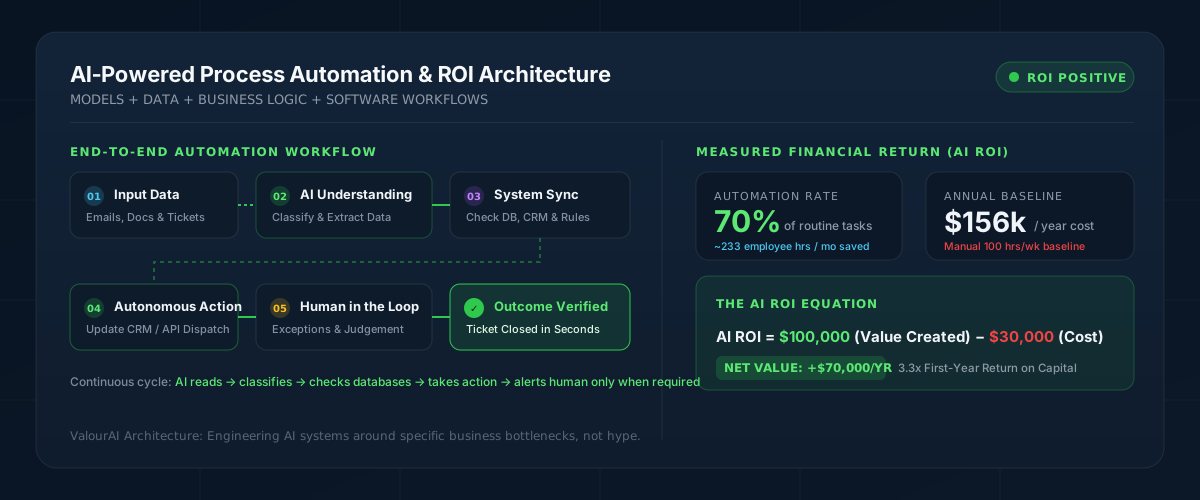
AI reads request → classifies intent → extracts structured data → validates against internal database → applies business logic → updates CRM → alerts a human only when confidence is low or policy demands approval.
That is not simply "using AI." That is business process automation driven by machine intelligence. And crucially, its financial return can be measured down to the penny.
How to Audit Workflows for Business Productivity
If your executive team wants to capture a genuine return on investment from AI, discard the impulse to ask: "Where can we plug in ChatGPT?"
Instead, begin with an unsparing operational question: "Where are we spending the most repetitive time and money across our business today?"
The highest-yielding opportunities for AI automation share three distinct traits: high volume, structured rules with room for pattern recognition, and heavy documentation. Audit your organization across these thirteen prime areas:
- Customer Support: Tier-1 triage, warranty claims, returns validation, and ticket routing.
- Sales Qualification: Inbound lead scoring, company research, enrichment, and tailored outreach.
- Data Entry & Extraction: Transcribing unstructured PDF forms, receipts, contracts, and shipping manifests.
- Document Processing: Loan applications, policy compliance, vendor onboarding, and KYC verification.
- Internal Knowledge Retrieval: Semantic search across legacy wikis, codebases, SOPs, and technical manuals.
- Financial Reporting: Gathering monthly ledger data, variance analysis, and draft board summaries.
- Invoice Processing: Three-way matching between purchase orders, receiving slips, and invoices.
- Compliance & Audit: Scanning contracts for non-standard clauses, liability caps, and regulatory risks.
- Research & Intelligence: Competitor price tracking, tender document analysis, and patent landscaping.
- Email Processing: Categorizing shared inboxes (e.g., billing@ or legal@) and dispatching actions.
- Lead Generation: Scraping directory signals, validating contact veracity, and mapping decision-makers.
- Software Engineering: Unit test generation, code refactoring, legacy migration, and documentation.
- Operational Logistics: Inventory replenishment alerts, dispatch coordination, and exception alerts.
The 4 Questions to Ask Before Deploying AI
Before allocating engineering capital or approving an AI budget, run every proposed initiative through four rigorous analytical filters.
1. How much does this process cost today?
You cannot evaluate an AI solution without establishing a clear cost baseline. Calculate fully loaded employee costs—including wages, taxes, benefits, and tooling overhead.
A concrete example: Suppose five operational staff members spend 20 hours each week manually processing incoming documents and reconciling data. That represents 100 employee hours every single week.
At an average fully loaded rate of $30 per hour, the arithmetic is straightforward:
- Weekly baseline cost: 100 hours × $30/hr = $3,000 / week
- Annual baseline expense: $3,000 × 52 weeks = $156,000 / year
Now you possess a concrete economic benchmark against which any proposed AI system must be judged.
2. Can AI automate part of the workflow?
One of the most dangerous misconceptions in AI strategy is believing an initiative must achieve 100% autonomous automation to be valuable. In reality, pursuing total autonomy for complex edge cases causes software budgets to balloon while reliability craters.
High-ROI implementations target the 70–80% repetitive core, leaving complex judgment calls to human operators:
- AI handles document extraction, categorization, data validation, initial drafting, and routing.
- Experienced human staff handle exceptions, flag edge cases, and provide final sign-off.
A "human-in-the-loop" architecture is dramatically safer to deploy, cheaper to engineer, and delivers 80% of the cost savings within weeks rather than years.
3. Can AI connect to the systems the company already uses?
This is where disconnected AI projects quietly fail. A standalone web portal or isolated chatbot may deliver impressive demos. But if that model cannot securely query your company's internal ecosystem, its utility is severely capped:
- CRM systems: Salesforce, HubSpot, or custom databases
- Enterprise ERPs: SAP, NetSuite, or Microsoft Dynamics
- Internal data stores: PostgreSQL, Snowflake, BigQuery, or vector indices
- Communication channels: Slack, Microsoft Teams, Zendesk, and corporate email
- Proprietary APIs: Business logic, billing engines, and inventory management
Real enterprise AI requires uniting four elements into one cohesive loop: Models + Proprietary Data + Software Integrations + Business Logic.
4. How will we measure ROI?
Define the exact success metrics prior to writing code or signing vendor agreements. Compare pre-deployment baseline operations against post-deployment performance.
| Metric | Before AI Automation | After AI Workflow Integration | Net Operational Gain |
|---|---|---|---|
| Volume Processed | 2,000 support tickets / month | 2,000 support tickets / month | Identical capacity maintained |
| Handling Time | 10 minutes per ticket | 3 minutes per ticket (AI-assisted) | 70% reduction in cycle time |
| Human Labor Required | 333 employee hours / month | 100 employee hours / month | 233 hours saved every month |
| Annual Financial Impact | $120,000 in labor expense | $36,000 labor + $12k AI software | $72,000 annual net savings |
Presenting a board or executive committee with "we saved 233 labor hours per month and improved SLA times by 70%" builds an undeniable business case. Presenting them with "our employees enjoy the new chat tool" does not.
Why AI Agents Outperform Traditional AI Assistants
The enterprise AI landscape is rapidly transitioning from passive chatbots to active autonomous and semi-autonomous AI agents. Understanding this distinction is vital for any technology leader planning capital allocation.
The distinction can be summarized in three words: Assisting vs. Doing.
- Traditional AI Assistant: Waits for a user prompt, interprets the request, and provides conversational text. ("Here are five prospective companies in the healthcare sector.")
- Integrated AI Agent: Receives an overarching objective, orchestrates multi-step subtasks across software tools, inspects the environment, and performs the work.
Consider a sales qualification and outbound motion. In an AI agent environment, the system executes an automated workflow without manual handoffs:
- Identifies potential prospects matching the Ideal Customer Profile (ICP).
- Researches recent corporate filings, funding news, and hiring updates.
- Identifies verified decision-maker emails via data provider APIs.
- Enriches the company's internal CRM record automatically.
- Scores the prospect based on fit and timing indicators.
- Drafts a hyper-personalized briefing note and initial email.
- Submits the draft to an account executive for one-click approval.
- Tracks response telemetry and logs follow-up reminders.
The goal is not to unleash unchecked autonomous bots across critical business systems. The goal is identifying specific operational lanes where AI agents can execute repetitive, multi-step workflows with high precision and safe guardrails.
Why Simply Buying AI Software Isn’t Enough
One of the costliest traps of the current AI boom is believing that software procurement alone solves productivity problems. Organizations spend tens of thousands of dollars on enterprise seat licenses for copilots, generative writing suites, and generic AI plugins—only to find that operational velocity remains virtually unchanged six months later.
Why does this occur? Because buying AI software is not the same as re-engineering your business around AI.
Sustainable enterprise transformation is built upon a 7-layer technology architecture:
The Enterprise AI Value Architecture
- Base AI Model: Foundation models (LLMs, vision models, embedding vectors) providing raw cognitive capabilities.
- Proprietary Company Data: Clean databases, product catalogs, customer histories, and documentation that provide essential business context.
- Deterministic Business Logic: Non-negotiable rules, regulatory constraints, permission tiers, and validation boundaries that AI cannot violate.
- Software Integrations: Robust API connectors bridging CRMs, ERPs, billing portals, and communication tools.
- Automated Workflow Engine: The operational spine dictating step sequencing, triggers, fallbacks, and escalations.
- Human Oversight: Well-designed review interfaces where subject matter experts quickly inspect, approve, or correct actions.
- Measurable Business Outcome: Hard economic deliverables—shorter cycle times, reduced labor cost, increased pipeline, or zero defect rates.
The commercial model is only the first layer. The true competitive moat is built in layers two through six.
The AI ROI Framework: Calculating Net Financial Value
To avoid vanity AI metrics, evaluate every prospective initiative through a disciplined return formula:
AI ROI = (Value Created) − (Cost of AI Implementation)
Where Value Created includes:
- Direct labor hours saved and recaptured
- Staff redirected from manual data manipulation to high-value client advisory
- Accelerated response times resulting in higher sales win rates
- Decreased SLA penalties and compliance error resolution costs
- Incremental revenue unlocked through 24/7 automated qualification
Where Cost of Implementation includes:
- Custom engineering, system integration, and API setup
- Ongoing model token consumption and infrastructure hosting
- Staff training and change management protocols
- Ongoing maintenance, monitoring, and model evaluation
The Contrast in Business Cases:
Suppose an intelligent document automation pipeline costs $30,000 to architect, integrate, and maintain over its first year. If that system eliminates $100,000 in outsourced data entry costs while cutting error rates in half:
$100,000 (Value) − $30,000 (Cost) = $70,000 Net First-Year Profit (233% ROI)
Now contrast that with an organization spending $30,000 on generic AI SaaS subscriptions because "competitors are talking about AI." At the end of the year, they have zero measured labor savings and an added recurring SaaS line item. One is a high-yield capital investment; the other is tech inflation.
Where Companies Should Start: A 5-Step Roadmap
Do not attempt to convert your entire enterprise into an AI-driven organization overnight. Broad, unfocused transformation initiatives usually succumb to scope creep, internal resistance, and murky accountability.
Instead, follow a phased, methodical playbook:
- Step 1: Identify One Pain Point Costing >$100,000/Year. Pinpoint a well-defined, repetitive process currently consuming substantial manual hours across customer support, billing reconciliation, or document verification.
- Step 2: Automate 30% to 50% of the Workflow. Target the most predictable, rules-bound aspects first. Connect the necessary database APIs and extract structured data automatically while keeping humans in the loop for final approval.
- Step 3: Measure the Real Financial Return. Track cycle times, error rates, and employee hours saved for 60 to 90 days. Calculate net savings against development costs.
- Step 4: Refine and Harden the System. Use edge-case data from the initial pilot to improve prompt schemas, add guardrails, fine-tune models if needed, and tighten business logic.
- Step 5: Scale to the Next Adjacent Workflow. Reinvest the capital and technical confidence gained from the first victory into the next bottleneck.
The ValourAI Perspective: Engineering AI Around Outcomes
At ValourAI, our philosophy regarding enterprise artificial intelligence is unambiguous: we do not build AI for the sake of novelty. We engineer intelligent systems around specific business bottlenecks to generate measurable financial outcomes.
Whether deploying custom multi-agent architectures, proprietary RAG (Retrieval-Augmented Generation) engines, intelligent document pipelines, or fintech automation systems, our focus remains squarely on return on investment:
- Deep Systems Integration: Ensuring AI models communicate directly with your existing enterprise software, CRMs, and core data stores.
- Enterprise Guardrails: Structuring deterministic business logic so AI agents operate safely and predictably within compliance guidelines.
- Production Reliability: Building scalable, resilient architectures that perform reliably under real-world enterprise traffic.
Ultimately, modern enterprises do not need more AI hype or unmeasured tools. They need better, faster, and more scalable businesses powered by sound AI engineering.
Frequently Asked Questions
How can our company calculate the ROI of an AI initiative?
Calculate AI ROI with the standard formula: Net ROI = (Total Value Created - Cost of Implementation) / Cost of Implementation. Value includes hours saved, reduced error rates, recaptured employee capacity, and faster customer response cycles. Baseline your current operational expense before building to measure the exact delta.
What is the difference between an AI assistant and an AI agent?
An AI assistant provides conversational information or generates static text in response to human prompts. An AI agent is empowered to execute multi-step actions across business systems—such as reading an incoming email, querying a database, validating an order, updating a CRM, and notifying a human only when necessary.
Why do enterprise AI tool subscriptions often fail to increase productivity?
Buying software seat licenses does not redesign broken operational workflows. When AI tools sit in separate browser tabs without bi-directional integration into enterprise databases, ERPs, and business logic, employees still spend the bulk of their time manually copy-pasting data and executing routine tasks.
Should our company try to fully automate processes with AI?
Rarely at the start. Pursuing 100% full autonomy is expensive and prone to failure on delicate edge cases. The most profitable approach is automating 60–80% of routine processing while keeping skilled human staff in the loop for exception handling and final approvals.
Which business functions benefit fastest from AI process automation?
High-volume, repetitive functions with clear inputs and structured outputs yield the fastest returns. These include customer support ticket triage, invoice matching and reconciliation, inbound sales qualification, contract review, and internal SOP knowledge retrieval.
Key Takeaways for Business Leaders
If your organization is currently investing in or planning an AI initiative, test your strategy against these five fundamental questions:
- 1. What exact business process are we improving? (Avoid vague answers like "productivity" or "efficiency"—name the specific workflow).
- 2. How much does that process cost today? (Know the annual baseline labor and error expenses in real currency).
- 3. What specific part of the workflow can AI automate? (Target the 70% repetitive heavy lifting, maintaining human oversight for judgment).
- 4. What systems, APIs, and databases does the AI need to touch? (Bridge the gap between language models and enterprise data infrastructure).
- 5. How will we measure financial ROI? (Establish pre-deployment benchmarks and track hours saved, costs reduced, and revenue unlocked).
If your organization can clearly answer all five, you are building an enduring AI strategy. If you cannot, you may simply be buying another technology subscription.
Keep reading on the ValourAI blog
- Inbound vs Outbound Marketing: Which One Actually Grows Your Business?
- Modernizing Legacy Systems Without Stopping the Business
- Shipping Multi-Tenant SaaS That Investors Take Seriously
- Engineering for Markets: Trading and Risk Systems That Hold Up
- Building Startup Products That Survive Success